Finessa Official Website › Blog › Finessa ingredients and supplement facts
What Is In Finessa? Ingredients And Supplement Facts, Read Plainly
Most people want the ingredients list first. Here it is, grouped the way the label groups it, with a plain note on what each group is and what the label does not tell you.
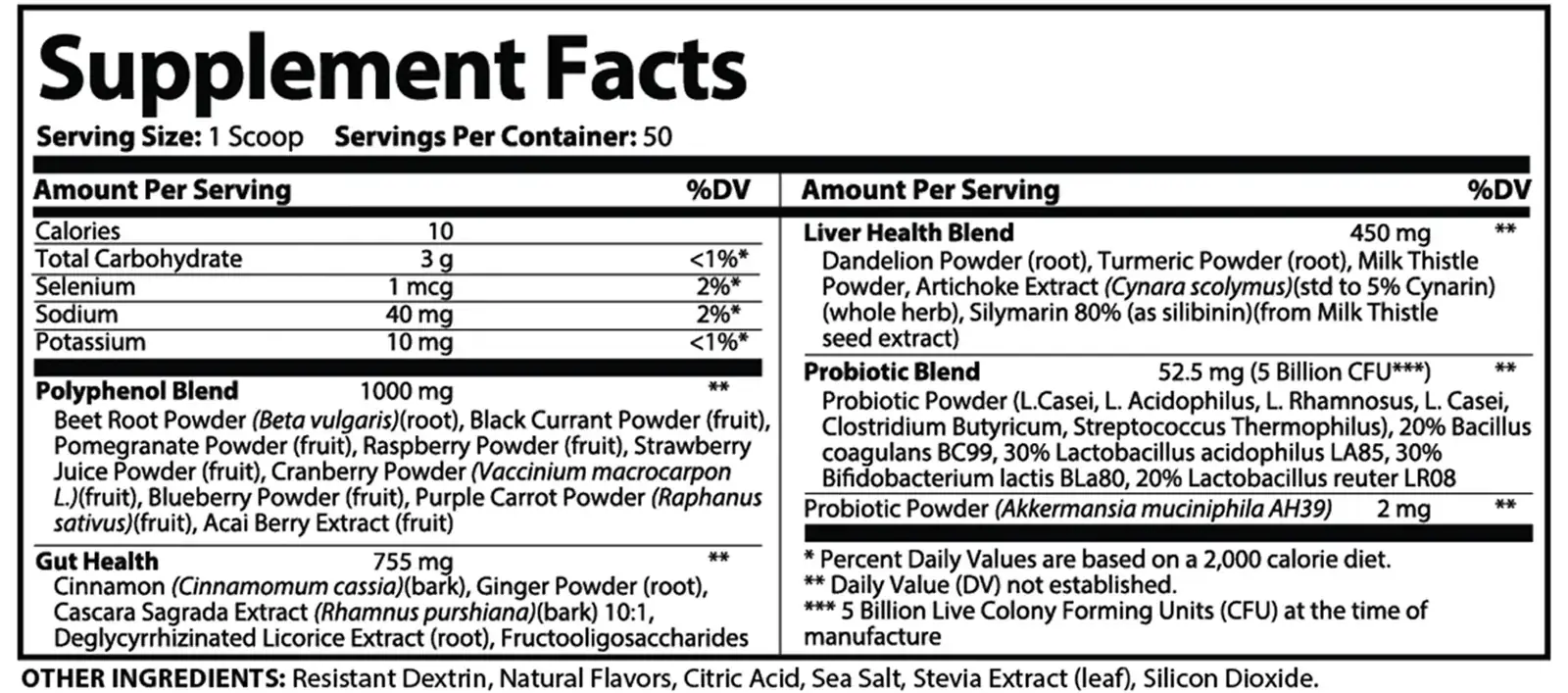
A Finessa scoop carries four blends: Polyphenol 1000 mg, Gut Health 755 mg, Liver Health 450 mg and Probiotic 52.5 mg, plus a 2 mg Akkermansia line. That is about 2.26 g, with 10 calories and 3 g of carbohydrate. No single ingredient has its own amount on the panel.
- Blend totals: Polyphenol 1000 mg, Gut Health 755 mg, Liver Health 450 mg, Probiotic 52.5 mg with 5 billion CFU at manufacture. A separate Akkermansia line is 2 mg.
- Per scoop: 10 calories, 3 g total carbohydrate, selenium 1 mcg, sodium 40 mg, potassium 10 mg.
- Other ingredients: resistant dextrin, natural flavors, citric acid, sea salt, stevia extract (leaf), silicon dioxide.
- Not published: the amount of any single ingredient, including cinnamon, ginger, cascara sagrada, milk thistle and dandelion.
- Panel and sales page differ. The printed panel is the label, so this site uses it.
Please read first. Finessa is a dietary supplement. It is not a drug, it is not FDA approved, and no supplement is. It is not meant to diagnose, treat, cure or prevent any disease. It is for healthy adults aged 18 and over, and not for anyone pregnant or nursing. Take medical questions to your doctor or pharmacist.
What does the Supplement Facts panel say?
| Blend | Total | Names printed inside it |
|---|---|---|
| Polyphenol Blend | 1000 mg | Beet root powder, black currant powder, pomegranate powder, raspberry powder, strawberry juice powder, cranberry powder, blueberry powder, purple carrot powder, acai berry extract |
| Gut Health | 755 mg | Cinnamon (Cinnamomum cassia) bark, ginger powder, cascara sagrada extract 10:1, deglycyrrhizinated licorice extract, fructooligosaccharides |
| Liver Health Blend | 450 mg | Dandelion powder, turmeric powder, milk thistle powder, artichoke extract standardised to 5% cynarin, silymarin 80% as silibinin from milk thistle seed extract |
| Probiotic Blend | 52.5 mg, 5 billion CFU | L. casei, L. acidophilus, L. rhamnosus, Clostridium butyricum, Streptococcus thermophilus; 20% Bacillus coagulans BC99; 30% Lactobacillus acidophilus LA85; 30% Bifidobacterium lactis BLa80; 20% Lactobacillus reuteri LR08 |
| Probiotic Powder | 2 mg | Akkermansia muciniphila AH39, on its own line |
Every blend is marked Daily Value not established. The four totals and the Akkermansia line come to about 2,259.5 mg, or about 2.26 g, in a scoop of about 3.2 g.
What do the nutrition facts show?
| Line | Per scoop | Daily Value |
|---|---|---|
| Calories | 10 | Not given |
| Total carbohydrate | 3 g | Under 1% |
| Selenium | 1 mcg | 2% |
| Sodium | 40 mg | 2% |
| Potassium | 10 mg | Under 1% |
This is a drink mix and not a meal. Ten calories is small by design. Selenium is the only micronutrient with a figure, at 1 mcg against an adult allowance of 55 mcg a day, so the tub is not a way to take selenium. The sodium comes from the sea salt in the other ingredients.
Want the full panel in front of you?
It is on the back of every tub. The checkout shows today's price and the guarantee terms.
See today's price and guaranteeGetfinessa earns money on orders placed through this website. The checkout shows the live price before any payment details are asked for.
What are the other ingredients?
- Resistant dextrin: a soluble fibre and the bulk that carries the rest. It belongs to the same inulin-type family as the fructooligosaccharides.
- Natural flavors: the berry note. A collective term, so the parts are not itemised.
- Citric acid: sharpness, and a mild preserving effect.
- Sea salt: the source of the 40 mg of sodium.
- Stevia extract (leaf): the sweetener. If you dislike stevia, know it is here.
- Silicon dioxide: a flow agent, to keep the powder loose enough to scoop.
The seal on the artwork says 100% Natural Ingredients. Natural has no set meaning for supplements, and the same panel lists citric acid and silicon dioxide. That is not a fault. It is a reminder to read the list and not the seal.
Which six ingredients does the seller lead with?
The supplier's record names six, and all six are on the panel: beet root, cranberry, cinnamon cassia bark, ginger root, dandelion root and milk thistle. The panel adds four more that the short list leaves out: cascara sagrada extract 10:1, turmeric, artichoke and deglycyrrhizinated licorice.
The one to read twice is cascara sagrada. It is a stimulant laxative, in a blend sold as prebiotic and probiotic support. Our safety post explains who should ask a pharmacist first.
| Name | What is published | What that means here |
|---|---|---|
| Cassia cinnamon | A Cochrane review used a mean of 2,000 mg a day for blood-sugar questions and found the evidence insufficient | The blend is 755 mg across five names. No blood-sugar claim is made here |
| Ginger | A single 1,200 mg dose changed stomach emptying time in a small trial, but symptoms did not change | A scoop cannot hold that much ginger |
| Cranberry | The strongest evidence is about urinary infections, not digestion | Finessa is not a urinary product |
| Dandelion | NCCIH: very little research exists | No dose to compare against |
| Milk thistle | NCCIH: not enough high-quality evidence. The largest trial used 2,100 mg a day for 48 weeks | The Liver Health Blend is 450 mg, shared with four names |
Why does the sales page list different ingredients?
The seller's page prints three different lists. The printed panel is the label, so it governs. Of the twelve names under the sales page's metabolism heading, only cinnamon and ginger are on the panel. Inulin shows up on the panel as fructooligosaccharides and resistant dextrin. The sales page's eight-item antioxidant blend is not the panel's nine-item Polyphenol Blend. Only blueberry, cranberry and pomegranate appear on both.
Names such as barley grass, spinach, asparagus, broccoli and spirulina appear on no panel at all. If a page tells you they are in Finessa, check the tub.
People also search for Finessa and blood sugar, cholesterol or polyphenols. The tub makes no blood sugar or cholesterol claim, and nothing in the sources this site cites supports one. Polyphenol is the heading of the 1000 mg blend of fruit and root powders.
What does the panel not tell you?
- The milligrams of any single botanical. The labelling rule lets a blend print one total, and this panel does.
- The amount of cascara sagrada, so the strength of its effect cannot be read off the label.
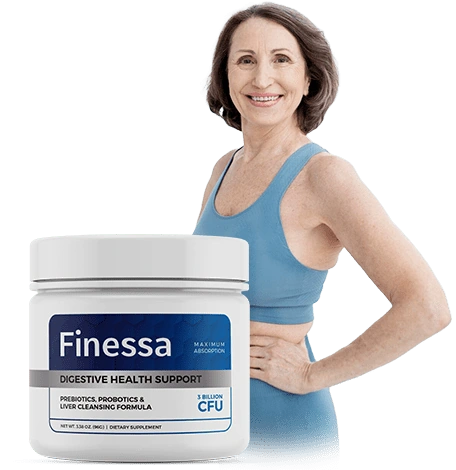
- A count of live cultures on the day you open the tub. The panel prints 5 billion CFU at manufacture. The tub front prints 3 billion.
- Any trial of the finished powder.
Frequently asked questions
What is in Finessa?
Four blends per scoop: Polyphenol 1000 mg, Gut Health 755 mg, Liver Health 450 mg and Probiotic 52.5 mg with 5 billion CFU at manufacture, plus a 2 mg Akkermansia line.
How much cinnamon or milk thistle is in a scoop?
Not published. The panel prints one total for each blend and no amount for any single name, so every figure is a ceiling shared with other ingredients.
Does Finessa contain cascara sagrada?
Yes. The Gut Health blend contains cascara sagrada extract 10:1, a stimulant laxative. The amount is not published.
What are the other ingredients in Finessa?
Resistant dextrin, natural flavors, citric acid, sea salt, stevia extract from the leaf and silicon dioxide.
How many calories are in a scoop of Finessa?
10 calories, with 3 g of total carbohydrate, 1 mcg of selenium, 40 mg of sodium and 10 mg of potassium.
Does Finessa help blood sugar or cholesterol?
The tub makes no such claim, and nothing in the sources this website cites supports one. The cinnamon blood-sugar evidence in one review was judged insufficient.
Our view
This is a better label than many. It names its plants, names its strains, lists its sweetener and its flow agent, and states a condition on its culture count. Those are good habits.
It is still a blend label. The one question buyers most want answered, how much of each, has no answer, and the sales page's other lists make the picture muddier. We follow the printed panel and we say where the seller goes beyond it.
Show the panel to your pharmacist if you take medicine. And if the panel raises a question for you, such as stevia, a daisy-family allergy or a stimulant laxative, ask it before the first scoop.
Read the label, then decide
The panel is the document that arrives. The guarantee runs 180 days from purchase.
See today's price and guaranteeGetfinessa earns money on orders placed through this website. The checkout shows the live price before any payment details are asked for.
Sources named on this website
- U.S. Code of Federal Regulations, 21 CFR 101.36. Nutrition labeling of dietary supplements. https://www.ecfr.gov/current/title-21/chapter-I/subchapter-B/part-101/subpart-C/section-101.36
- Leach MJ, Kumar S. Cinnamon for diabetes mellitus. Cochrane Database Syst Rev. 2012;2012(9):CD007170. https://pubmed.ncbi.nlm.nih.gov/22972104/
- Hu ML, Rayner CK, Wu KL, et al. Effect of ginger on gastric motility and symptoms of functional dyspepsia. World J Gastroenterol. 2011;17(1):105-10. https://pubmed.ncbi.nlm.nih.gov/21218090/
- Williams G, Stothart CI, Hahn D, Stephens JH, Craig JC, Hodson EM. Cranberries for preventing urinary tract infections. Cochrane Database Syst Rev. 2023;11(11):CD001321. https://pubmed.ncbi.nlm.nih.gov/37947276/
- National Center for Complementary and Integrative Health. Dandelion: Usefulness and Safety. https://www.nccih.nih.gov/health/dandelion
- National Center for Complementary and Integrative Health. Milk Thistle: Usefulness and Safety. https://www.nccih.nih.gov/health/milk-thistle
- Wah Kheong C, Nik Mustapha NR, Mahadeva S. A Randomized Trial of Silymarin for the Treatment of Nonalcoholic Steatohepatitis. Clin Gastroenterol Hepatol. 2017;15(12):1940-1949.e8. https://pubmed.ncbi.nlm.nih.gov/28419855/
- NIH Office of Dietary Supplements. Selenium: Fact Sheet for Consumers. https://ods.od.nih.gov/factsheets/Selenium-Consumer/
- MedlinePlus, U.S. National Library of Medicine. Dietary Fiber. https://medlineplus.gov/dietaryfiber.html