Finessa Official Website › Blog › Reading a blend panel
Four Blend Totals, Nineteen Names: Reading This Panel
Four totals, nineteen named plants and no figure beside any one of them. There is a correct way to read a panel written like this, and it produces a ceiling rather than an amount. The rule that permits the blend is also the rule that says what still has to appear.
- Four totals do the work of nineteen figures. Polyphenol Blend 1000 mg, Gut Health 755 mg, Liver Health Blend 450 mg, Probiotic Blend 52.5 mg, plus a 2 mg Akkermansia line.
- A blend total is a ceiling. No item inside a blend can exceed the total, and every item shares it. That is the most a reader can honestly conclude.
- Order is the only other clue. Ingredients inside a blend are listed in descending order of predominance by weight, so the first name outweighs the last. It does not say by how much.
- The seller prints three other lists. Only the Supplement Facts panel is the label, and two of those lists name plants that appear on no panel at all.
What the panel actually prints
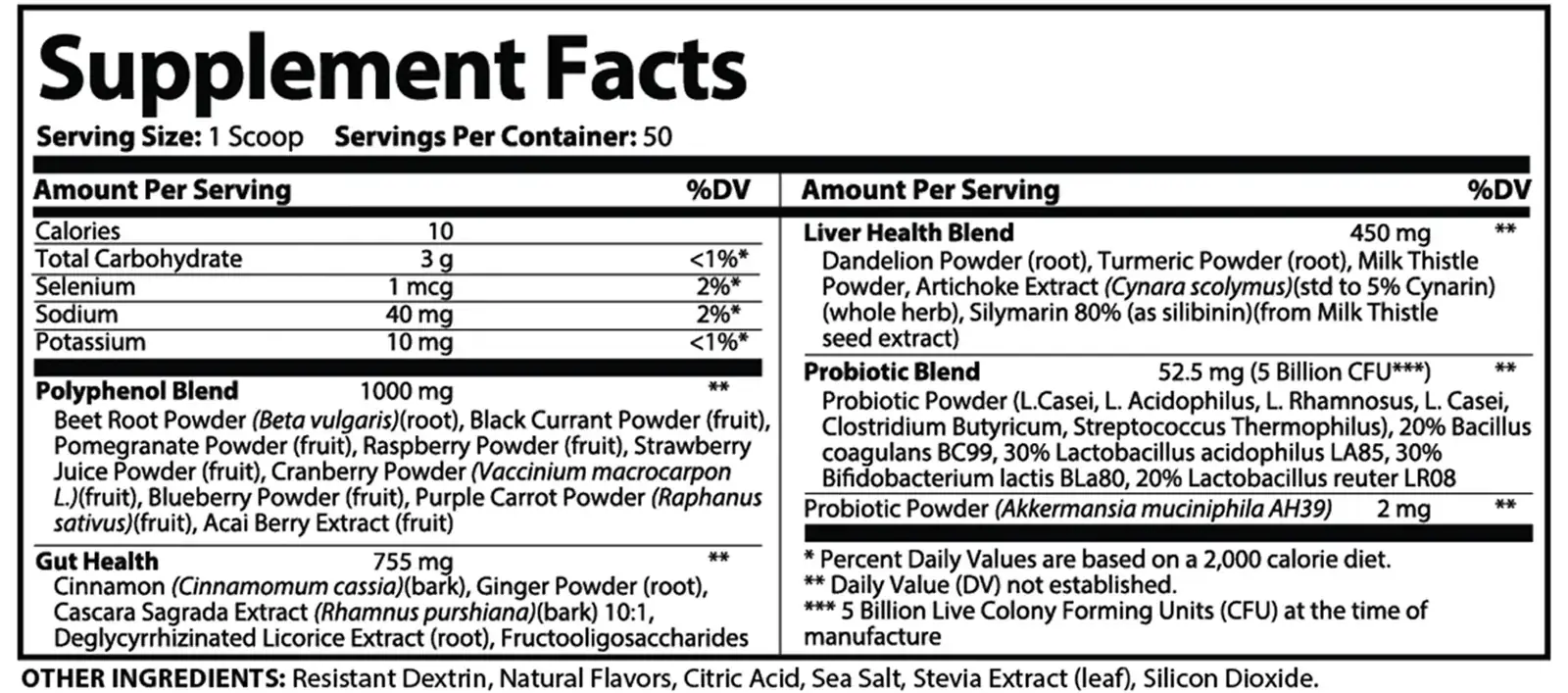
Here is the panel, transcribed — five nutrition lines with real figures, then four blends with one total each.
| Per serving | Amount | Daily Value |
|---|---|---|
| Calories | 10 | — |
| Total Carbohydrate | 3 g | under 1% of the Daily Value |
| Selenium | 1 mcg | 2% of the Daily Value |
| Sodium | 40 mg | 2% of the Daily Value |
| Potassium | 10 mg | under 1% of the Daily Value |
| Polyphenol Blend Beet Root Powder (Beta vulgaris) (root); Black Currant Powder (fruit); Pomegranate Powder (fruit); Raspberry Powder (fruit); Strawberry Juice Powder (fruit); Cranberry Powder (Vaccinium macrocarpon L.) (fruit); Blueberry Powder (fruit); Purple Carrot Powder (Raphanus sativus) (fruit); Acai Berry Extract (fruit) | 1000 mg | Daily Value not established |
| Gut Health Cinnamon (Cinnamomum cassia) (bark); Ginger Powder (root); Cascara Sagrada Extract (Rhamnus purshiana) (bark) 10:1; Deglycyrrhizinated Licorice Extract (root); Fructooligosaccharides | 755 mg | Daily Value not established |
| Liver Health Blend Dandelion Powder (root); Turmeric Powder (root); Milk Thistle Powder; Artichoke Extract (Cynara scolymus), standardised to 5% cynarin (whole herb); Silymarin 80% as silibinin, from milk thistle seed extract | 450 mg | Daily Value not established |
| Probiotic Blend Probiotic Powder: L. casei, L. acidophilus, L. rhamnosus, Clostridium butyricum, Streptococcus thermophilus; 20% Bacillus coagulans BC99; 30% Lactobacillus acidophilus LA85; 30% Bifidobacterium lactis BLa80; 20% Lactobacillus reuteri LR08 | 52.5 mg, 5 billion CFU | Daily Value not established |
| Probiotic Powder (Akkermansia muciniphila AH39) | 2 mg | Daily Value not established |
As printed on the panel shipped with the seller’s artwork. Serving size one scoop. Other ingredients: Resistant Dextrin, Natural Flavors, Citric Acid, Sea Salt, Stevia Extract (leaf), Silicon Dioxide.
Read the first five rows and the last five differently. Calories, carbohydrate, selenium, sodium and potassium are quantified. The four blends carry a total apiece and the words that the Daily Value is not established, which is what the labelling rule says to print when no reference value has been set. The panel page sets the whole thing out line by line.
Why a blend total is lawful, and what it costs
A proprietary blend is not a loophole and it is not a trick. 21 CFR 101.36 sets out how a Supplement Facts panel is written and expressly allows a blend to be declared as one total, with the dietary ingredients in it listed beneath. The seller is not withholding anything it is obliged to print.
What it costs the reader is the thing that matters. Without a per-name figure you cannot set an ingredient against the amount its own research used, and you cannot tell whether a plant near the end of a list is there at a working amount or at a pinch. The claims a supplement is allowed to make are structure and function claims, which do not require an amount either. The ingredients page says so on every row.
Ingredient order, and how much it is worth
Inside each blend the names are listed in descending order of predominance by weight. That is real information and it is free — in the Gut Health blend, cassia cinnamon bark outweighs ginger, which outweighs the cascara sagrada extract, which outweighs the deglycyrrhizinated licorice, which outweighs the fructooligosaccharides.
Then stop, because the ordering says nothing about the gaps. A 755 mg blend split 751, 1, 1, 1, 1 is in descending order. So is one split 200, 180, 150, 130, 95. Both fit everything the label prints, and nothing on the tub chooses between them. The rule asks for the order, not the distribution, and the panel page prints it as the artwork does.
The only honest arithmetic is a ceiling
There is exactly one calculation this panel supports — the most an item could be, if it were the entire blend. It never is, because the others are in there too, but a ceiling is a real bound and it is often enough to settle a question.
| Ingredient | What the published research used | The ceiling here | Share of the research amount |
|---|---|---|---|
| Cassia cinnamon | 2,000 mg a day, the Cochrane mean | 755 mg, shared with four others | at most 38% |
| Ginger | 1,200 mg, a single dose | 755 mg, shared with four others | at most 63% |
| Fructooligosaccharides | 12,000 mg a day in the constipation trial | 755 mg, shared with four others | at most 6.3% |
| Fructooligosaccharides | 15,000 mg a day in the application EFSA rejected | 755 mg, shared with four others | at most 5.0% |
| Milk thistle, as silymarin | 2,100 mg a day for 48 weeks | 450 mg, shared with four others | at most 21% |
| Selenium | 55 mcg a day, the adult RDA | 1 mcg, declared outright on the panel | 1.8% |
| Beet root | 200 to 800 mg of nitrate a day, from juice | 1,000 mg of powder, shared with eight others, no nitrate figure printed | not comparable |
| Cranberry | juices and tablets, with no clear dose-response | 1,000 mg, shared with eight others, no proanthocyanidin figure printed | not computable |
| Dandelion | no dose to compare against | 450 mg, shared with four others | — |
Every figure in the third column is a ceiling and not an amount. The named plant shares its blend with four or eight others, so the real figure is lower and the panel does not print it.
Look at the fructooligosaccharides row. The randomised trial that moved bowel frequency gave 12 g of chicory inulin a day for four weeks. The whole Gut Health blend is 755 mg, shared with four other items, so the fibre in a scoop is at most six per cent of that trial amount even before the sharing. The panel’s own 3 g of total carbohydrate caps it again. The how-it-works page works through the same logic blend by blend.
Ninety scoops, and the panel in full
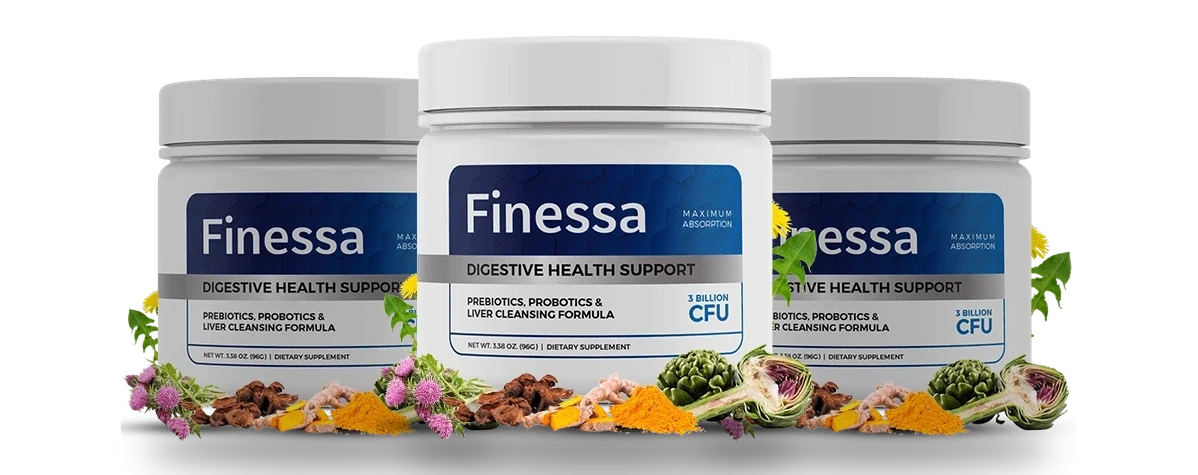
Every figure in this article comes off the label. The three-tub pack is the middle rung of the seller’s own ladder and covers the wait the reviewers describe.
$39 to $59 a tub · 180 days to change your mind
Order Finessa On The Official WebsiteOne worked row: the cassia cinnamon line
Cassia cinnamon is the first name in the Gut Health blend — which makes it the heaviest item in it. The Cochrane review of cinnamon pooled ten trials of 577 people at a mean of 2 g a day, predominantly this same species, for four to sixteen weeks. Its conclusion was that the evidence is insufficient: no significant difference in HbA1c, in serum insulin or in postprandial glucose.
So two things are true at once. The ceiling here is 755 mg against a 2,000 mg trial mean, which is at most 38 per cent and in reality less. And the trials at the full amount did not produce the result the seller’s metabolism copy implies. The species matters for a second reason, which the safety page takes up: the panel specifies Cinnamomum cassia rather than Ceylon, and the two differ in coumarin.
Three other lists, and none of them is the panel
The seller’s material carries three ingredient lists besides the Supplement Facts panel — and they do not agree with it, or with each other.
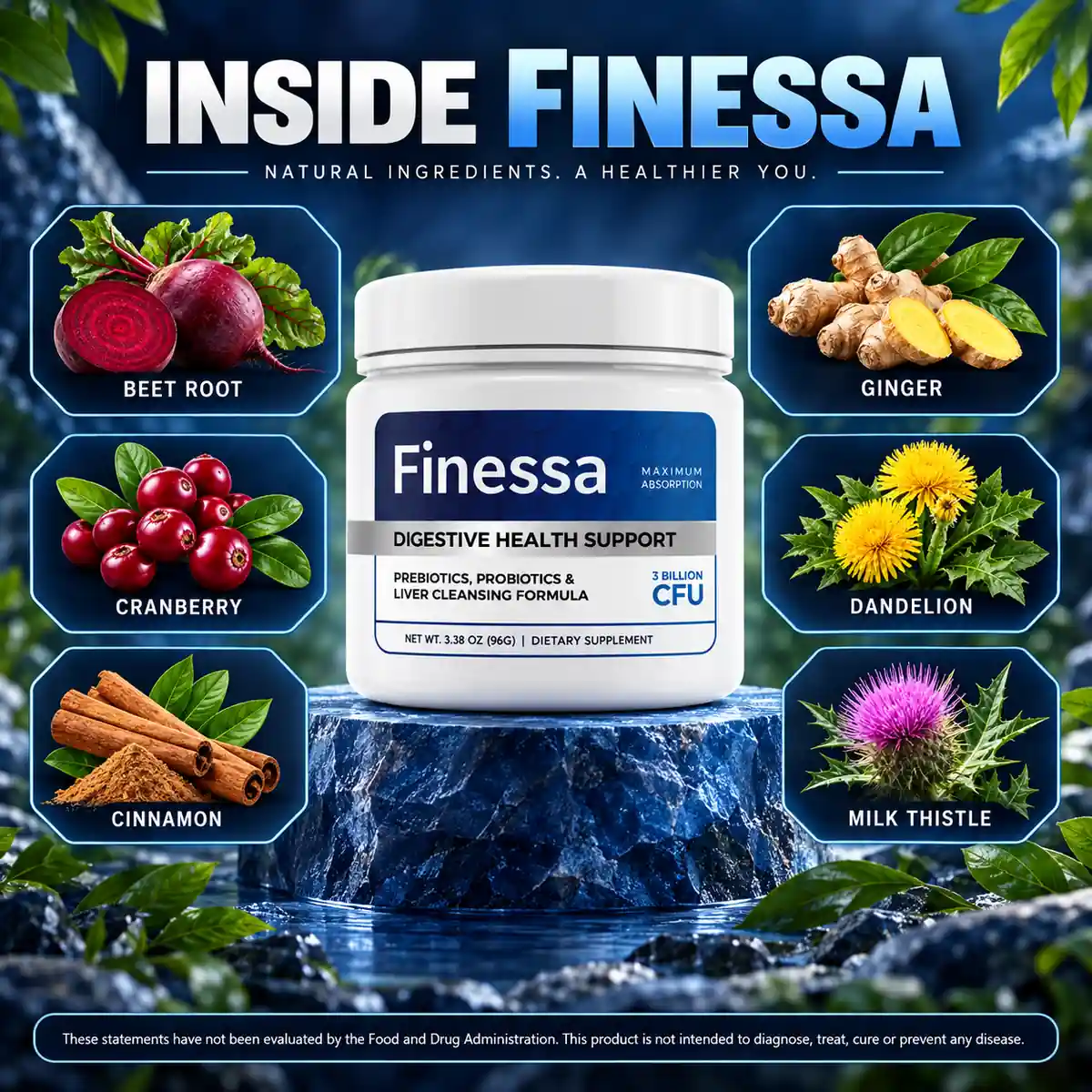
- The ingredient artwork names eight. Those eight are the panel’s liver and gut names plus two of its blend headings, so the artwork is a picture of the panel rather than a rival list.
- The sales page names twelve more under a metabolism heading, with a photograph for each. Of the twelve, only cassia cinnamon and ginger are on the panel; inulin appears there under the names fructooligosaccharides and resistant dextrin.
- The sales page also names an eight-item antioxidant blend. It is not the panel’s nine-item Polyphenol Blend. Only blueberry, cranberry and pomegranate appear on both, and barley grass, spinach, asparagus, broccoli and spirulina appear on no panel at all.
The label is the source that governs, and that is not a small preference: the structure and function rules apply to what the label says. The ingredients page prints the panel’s list and marks which of the seller’s other names are on it.
Five questions to ask any blend panel
These five work on any label in this category, not only this one.
- How many names share the total? Five names in 755 mg is a different proposition from five names in 3,000 mg.
- Which name is first? Descending order by weight makes the first name the largest single item in that blend.
- Is there a standardisation anywhere? A percentage, as in artichoke standardised to 5 per cent cynarin, is the one piece of wording a reader can convert.
- What did the research use? The silymarin trial gave 2,100 mg a day for 48 weeks and still missed its primary endpoint. A number without the result beside it is half a fact.
- What does the nutrition part cap? Here, 3 g of total carbohydrate caps every gram of fibre in the scoop, whatever the blend order implies.
What a better label in this category would print
Three changes, none of which would give away a formula.
- A milligram beside each name. The blend can keep its heading; the parts can still be printed.
- A standardisation where one exists. The panel already does this for artichoke and for silymarin. Doing it for the cascara sagrada extract would tell a reader far more than the 10:1 ratio does on its own.
- A count and a date for the live cultures. Measured at the time of manufacture is not the same promise as a count at the end of shelf life.
None of that is required by the panel rule, which is why printing it would mean something. The batch page lists what a lot code can and cannot settle.
What this panel does still tell you
Ending on the gap would be a poor reading. This panel names nineteen plants, prints four totals that add to 2,259.5 mg (about 2.26 g), declares its sodium and potassium and gives a strain list for the probiotic blend. A great many labels in this category print a shorter list and a rounder number.
It also lets you rule things out, which is underrated. The ginger trial most often cited in this category gave 1.2 g as a single dose and found the stomach emptied faster while symptoms did not change. With the blend ceiling in front of you, you can say plainly that a scoop is not delivering that. The how-it-works page is built on that habit.
Sources cited in this article
- U.S. Code of Federal Regulations, 21 CFR 101.36. Nutrition labeling of dietary supplements. https://www.ecfr.gov/current/title-21/chapter-I/subchapter-B/part-101/subpart-C/section-101.36
- U.S. Food and Drug Administration. Structure/Function Claims. https://www.fda.gov/food/nutrition-food-labeling-and-critical-foods/structurefunction-claims
- Leach MJ, Kumar S. Cinnamon for diabetes mellitus. Cochrane Database Syst Rev. 2012;2012(9):CD007170. https://pubmed.ncbi.nlm.nih.gov/22972104/
- Micka A, Siepelmeyer A, Holz A, Theis S, Schön C. Effect of consumption of chicory inulin on bowel function in healthy subjects with constipation: a randomized, double-blind, placebo-controlled trial. Int J Food Sci Nutr. 2017;68(1):82-89. https://pubmed.ncbi.nlm.nih.gov/27492975/
- Wah Kheong C, Nik Mustapha NR, Mahadeva S. A Randomized Trial of Silymarin for the Treatment of Nonalcoholic Steatohepatitis. Clin Gastroenterol Hepatol. 2017;15(12):1940-1949.e8. https://pubmed.ncbi.nlm.nih.gov/28419855/
- Hu ML, Rayner CK, Wu KL, et al. Effect of ginger on gastric motility and symptoms of functional dyspepsia. World J Gastroenterol. 2011;17(1):105-10. https://pubmed.ncbi.nlm.nih.gov/21218090/
Order Finessa on the official website
One scoop a day, thirty scoops a tub, and 180 days to change your mind.
$39 to $59 a tub · 180 days to change your mind
Order Finessa On The Official WebsiteThree e-books with an order · 180-day money-back guarantee · lot FIN-26/GE-7289